Archive
- January (22)
- February (20)
- March (23)
- April (21)
- May (20)
- June (21)
- July (22)
- August (22)
- September (22)
- October (19)
- November (0)
- December (0)
Another PTC/ITC Extension for Wind/Solar? Just Say NO
By Robert Bradley Jr. -- May 1, 2026“The continued reliance on ‘clean’ energy tax credits is a political crutch…. Those who have introduced this legislation … should be working to phase out these subsidies more quickly, not doubling down on them.” – Tom Pyle, AEA president (below)
A recent press release by the American Energy Alliance (the advocacy arm of the Institute for Energy Research) called it an “Election-Year Betrayal to Reinstate Wind and Solar Subsidies.” For two energies touting their affordability for consumers, this is disingenuous. Socializing the cost-premium to taxpayers, and unnecessarily industrializing the pristine landscape (real ecologists, please stand up) is bad public policy. And with more than a dozen extensions of the “temporary tax credits” (15 for solar, 14 for wind), the mirage of competitiveness by an infant industry (not) is exposed.…
IPCC Troubles: The Latest from Bangkok
By Robert Bradley Jr. -- April 28, 2026“This is the fifth consecutive failed attempt…. UNEP warns the IPCC trust fund may run out before AR7 is even finished. What we are watching is … a slow-motion erosion of the institution that translates climate science into political accountability — and it is happening at the moment that science is most needed.” – Jozef Pecho, IPCC climate scientist (below)
There is trouble in IPCC-land where the next (Seventh) assessment, due out in late 2029 (COP 34), is behind schedule with uncertain prospects.[1] Chalk up another setback to the Big Problem of trying to control the climate via anti-CO2 policies.
Climate modeler Jozef Pecho, advertising himself as “predicting floods, protecting lives,” is concerned that the IPCC research-and-publication process is in trouble. “As a climate scientist whose work depends on IPCC assessments,” he reported, “I find what’s happening in Bangkok hard to watch.”…
The ‘Climate Change’ Bottom Line
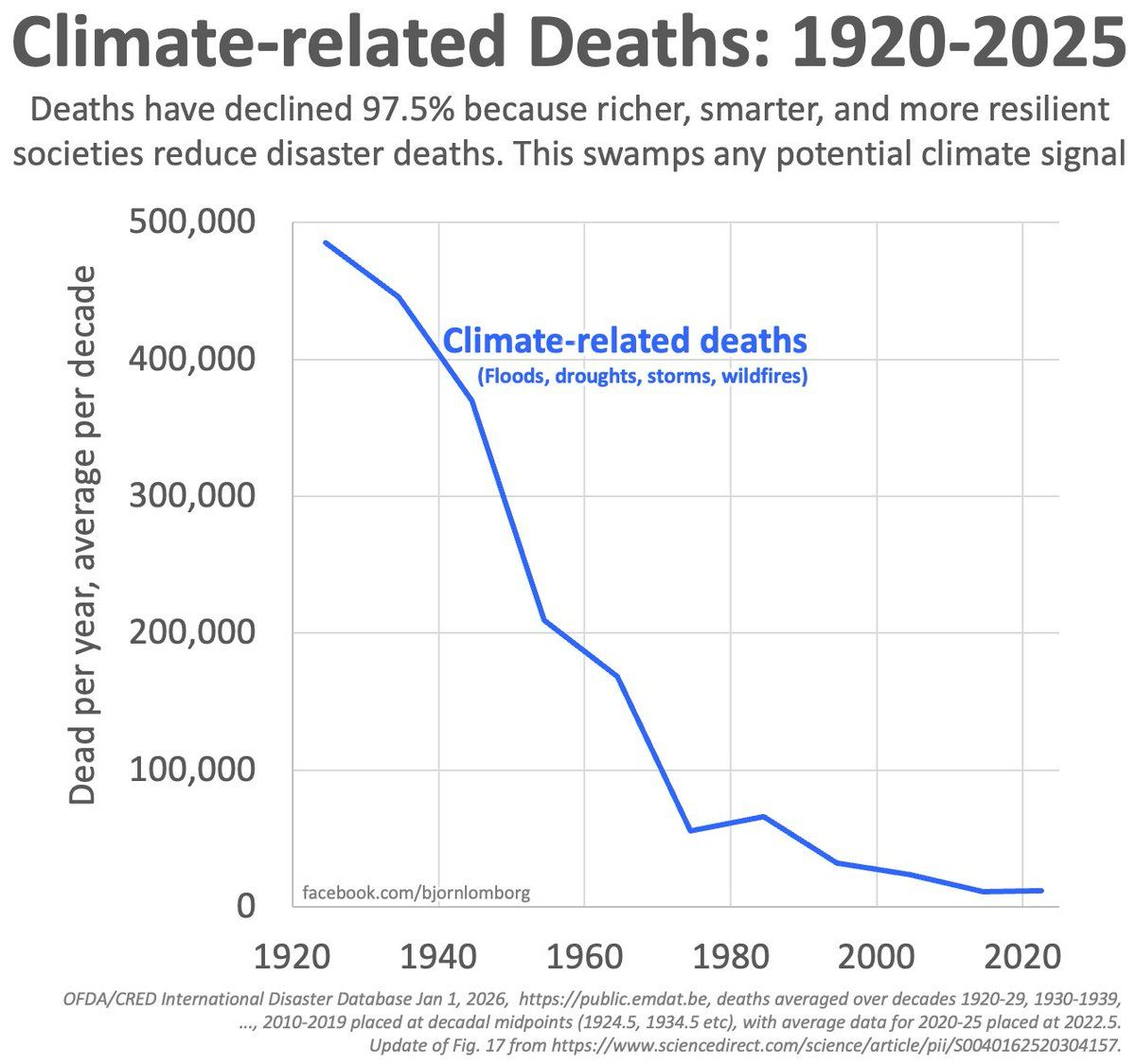
By Robert Bradley Jr. -- April 24, 2026Reports Bjorn Lomborg:
Climate-related disaster deaths have declined 97.5% over the century (1920-2025). Richer, smarter, and more resilient societies reduce disaster deaths. This swamps any potential climate signal.
Why not reported? Instead, media only delivers climate doom