Archive
- 2027
- 2026
- 2025
- 2024
- 2023
- 2022
- 2021
- 2020
- 2019
- 2018
- 2017
- 2016
- 2015
- 2014
- 2013
- 2012
- 2011
- 2010
- 2009
- 2008
- 202
- January (23)
- February (20)
- March (23)
- April (21)
- May (20)
- June (21)
- July (22)
- August (22)
- September (22)
- October (23)
- November (20)
- December (0)
Fossil Future: 86 Percent Global Market Share (energy transition not)
By Robert Bradley Jr. -- January 6, 2026IER, “Fossil Fuels Dominate Global Energy Supply in 2025“
The Energy Institute’s Statistical Review of World Energy, with data for 2025, has been released and shows that fossil fuels still provide 86% of the global energy supply.
2
Global energy supply rose by 1.7% in 2025, with all fuels increasing slightly, resulting in new records.
3
Renewables continued to grow, driven by government subsidies and mandates worldwide, with solar power accounting for 71% of the increase in 2025.
4
The drive to electrify more of the world’s economies and to expand AI data centers led to a 3% increase in electricity demand in 2025, outpacing the increase in energy supply.
5
Carbon dioxide emissions from energy rose worldwide in 2025, at a growth rate of 1.1%.
6
China remained the largest emitter of carbon dioxide, with a 31.3% share of global emissions, up 0.7% in 2025.…
Thirty Failed Climate Forecasts (optimism please)
By Robert Bradley Jr. -- January 2, 2026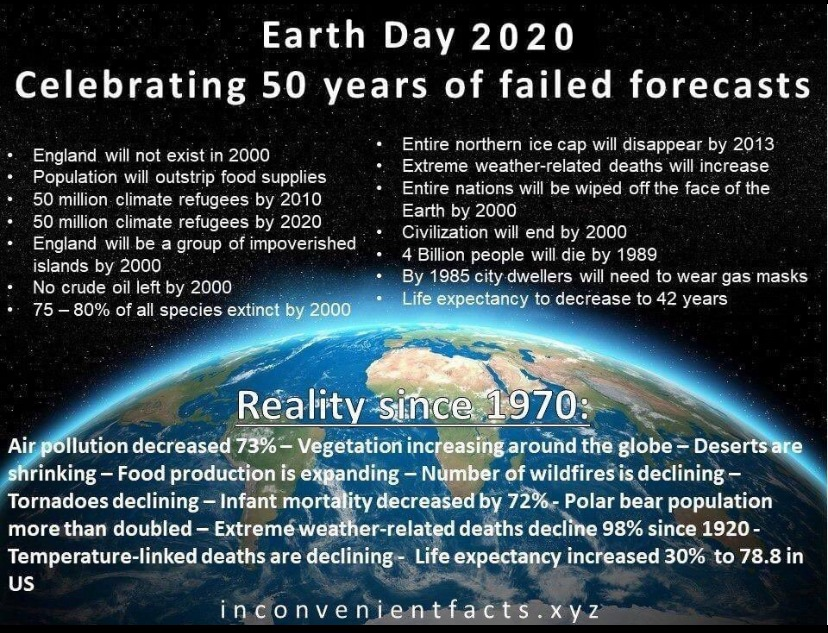
Martin Ecclestone on social media (November 4, 2025) usefully provided a historical review of climate exaggeration. “Educate yourself,” he began. “Uninformed personal opinions don’t change facts.”
Here’s a list [30] of the major climate-change impacts that climate scientists predicted and that have already eventuated (observed and documented in the scientific literature and major assessments). I’ve kept each item short — if you want, I can expand any item with dates, regions, or citations.
1. Global mean surface temperature rise (planet warming).
2. More frequent and/or more intense heatwaves (land).
3. Ocean warming (upper ocean and deep ocean temperature increase).
4. Global sea-level rise (mean sea level increase).
5. Melting of glaciers and mountain ice (glacial retreat).
6. Loss and thinning of Arctic sea ice (decline in extent and volume).
7.…
More Tributes in the Energy and Climate Debate (Part II)
By Robert Bradley Jr. -- December 30, 2025Ed. Note: This repost from seven years ago (January 11, 2018) is reprinted for its relevancy today. What 12 or more would you add today? Here are some of mine: Craig Idso, Jr., Anthony Watts (WUWT), Kevin Dayaratna, and the other four DOE science study authors in addition to Judith Curry, profiled yesterday (John Christy, Steven Koonin, Ross McKittrick, Roy Spencer).
I previously recognized twelve individuals associated with free-market, classical-liberal energy analysis and advocacy. Here is a second “tribute” to those who have labored against the mainstream of Malthusianism and energy statism–and now find themselves with new opportunities to formulate, summarize, and promote pro-consumer, taxpayer-neutral energy policy.
This list is in alphabetical order. It is subjective and hardly exhaustive. Other candidates (such as the present writer) could also be included–and could be in a future iteration.…