Archive
- January (22)
- February (20)
- March (23)
- April (21)
- May (20)
- June (21)
- July (22)
- August (22)
- September (22)
- October (19)
- November (0)
- December (0)
Climate Collapse! Four Billion to Perish?
By Robert Bradley Jr. -- September 21, 2026“The doom industry is alive and well despite a litany of failed predictions along the way…. Statism and statism alone can cause mass destruction and deaths, as proven in the 20th century…. The ‘insurance policy’ against this is a free society based on private property rights, voluntary exchange, and the rule of law.”
The world’s most viewed climate website (WUWT) contains a list of the exaggerated, failed apocalyptic predictions from neo-Malthusians in the last half century. So I was surprised to see this new prediction making the rounds.
Mark Campbell, “environmental journalist and communicator,” posted at his website: “Insurers Say Half the World Could Be Killed by Climate Change” (June 11, 2026). I learned of him and this prediction in a LinkedIn exchange where he protested against Michael Shellenberger’s “Caught Pushing an Apocalyptic Scenario They Knew Couldn’t Occur, Climate Scientists Are Now Claiming Their Policies Prevented It.”…
Why ‘Feel Good’ Climate Activism?
By Robert Bradley Jr. -- September 17, 2026Sam Belfied in his essay, “Climate Activism: ‘It Made Me Feel Like a Good Person’” (August 19, 2026), has a number of interesting insights on the motivations of climate campaigners given the intellectual case that their cause is both futile and wasteful. And ecologically damaging (think wind and solar industrialization). Excerpts follow verbatim; footnotes can be found in the original.
The following commentary and research findings suggest that climate ideology and activism are psychological compensatory responses to painful, emotional, subjective, and even existential aspects of the self. Specifically, the material suggests a deeper and collective psychological malaise, of which anxiety and distress about climate change are an expression, not the root cause….
The climate movement involves guilt, self-loathing and seeking redemption
In discussing the emotions motivating climate activists, commentators have proposed ‘guilt,’ ‘self-flagellation,’ ‘sin,’ ‘self-loathing’ , ‘conscience’, and seeking ‘atonement’ and ‘redemption.’…
Energy Future: CO2 Enrichment Ahead (de-decarbonization)
By Robert Bradley Jr. -- September 16, 2026“There is no renewables ‘transition’ – ONLY addition.” (below)
The much-hyped “energy transition” has predictably failed. Grant Lukies presented the chart below and reported on social media:
For those of you paying attention – still no ‘transition’ evident whatsoever (to August 2025). 33 years of IPCC stewardship and panic and $billions spent and absolutely zero downward trend in slope of the curve.
THIS is THE failed KPI of alarmist catastrophism writ large. There is no renewables ‘transition’ – ONLY addition.
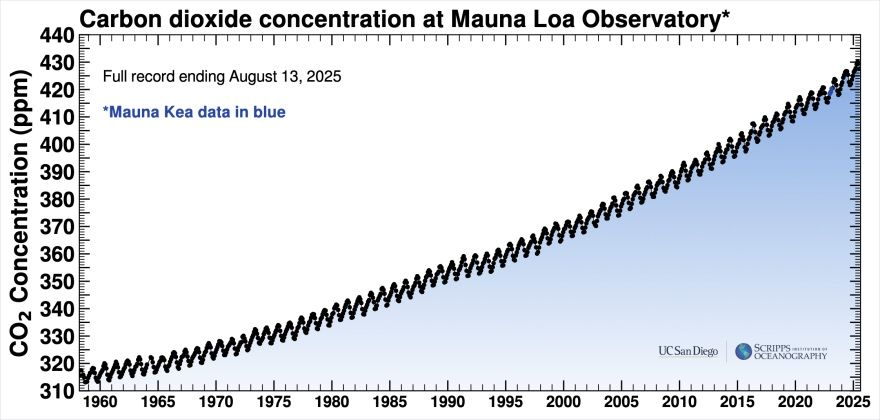
Is this bad news? Hardly. The plants rejoice as CO2 enrichment continues. A greener Planet Earth is surely better than wind, solar, and battery industrialization from all points of view.
Remember what Daniel Yergin concluded in The New Map: Energy, Climate, and the Clash of Nations (2020), p. 422:
…As they grow, wind and solar and EVs will need ‘big shovels’ to meet their increasing call on mined minerals and land itself.