Search Results for: "Ken Lay"
Relevance | DateEnergy at the Speed of Thought (Part 3: How Oil Rose to Prominence)
By Alex Epstein -- December 22, 2010 3 Comments[Editors note: This is part 3 of 4 in Alex Epstein’s exploration of innovation and creative destruction of the early oil market. Read Part 2 here. References are at the bottom. This post was originally published in The Objective Standard.]
George Bissell was the last person anyone would have bet on to change the course of industrial history. Yet this young lawyer and modest entrepreneur began to do just that in 1854 when he traveled to his alma mater, Dartmouth College, in search of investors for a venture in pavement and railway materials. 26 While visiting a friend, he noticed a bottle of Seneca Oil—petroleum—which at that time was sold as medicine. People had known of petroleum for thousands of years, but thought it existed only in small quantities.…
Continue ReadingCape Wind: Spreading the Pain
By Lisa Linowes -- December 13, 2010 8 CommentsThe headlines were abuzz last month following Energy Secretary Steven Chu’s talk at the National Press Club where he dubbed the global race for clean energy our new “Sputnik Moment” and warned that the U.S. risked falling behind other countries. In this imaginary race, our competition is no longer the Soviet Union, but China, which now leads in the manufacture of wind turbines and solar panels.
The Sputnik analogy is inappropriately applied for obvious reasons. The U.S. space program of the mid-twentieth century was an outgrowth of our military at a time when the United States and Soviet Russia were researching long-range ballistic missiles. The program was a high-cost, high-risk venture that never achieved economies of scale, nor was it intended to. There’s no question the race advanced us technologically and the productization of its research benefited generations of Americans.…
Continue ReadingEnergy and Poverty – What is Really at Stake in Cancun
By Donald Hertzmark -- December 6, 2010 8 CommentsA year ago during the Copenhagen conference on climate change, I published a post, Electricity for the Poor–What Copenhagen Really Needs to Confront, where I noted that some 1.5 billion people did not have access to reliable electricity supplies. To update this, there is more electricity generated this year than last, mostly due to newly commissioned large conventional sources of electric power – gas, coal, hydro, nuclear. The new estimate is 1.4 billion living in energy squalor.
To hear the good and the great at Cancun, the sustainability issue of energy poverty is hidden. Occasionally, one of the climate-change grandees slips up and admits that this the real subject is wealth redistribution, not climate. But that is about as close as it gets.
All the more reason that the international forums on climate change, energy environment, and the like should get to first principles and study this map: The World At Night (courtesy of Bert Christensen)
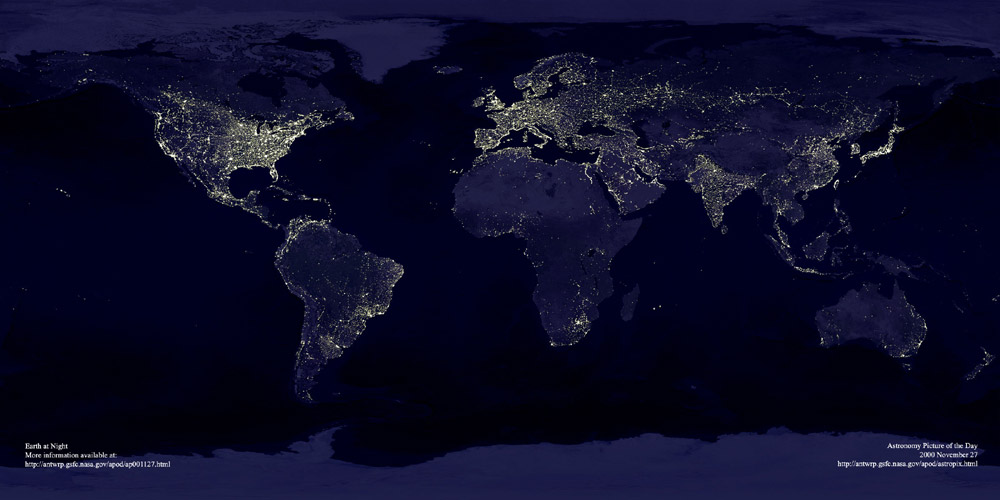
When you fly overnight from Johannesburg to Europe the lights thin out just north of Lusaka, Zambia, a few more in Zambia’s Copper Belt and then nothing (and I mean nothing) until the North African coastline. …
Continue ReadingThe Calculator: Fossil Fuel Consumption, CO2 Emissions, and Costs with Wind (Part I)
By Kent Hawkins -- November 29, 2010 25 Comments[Editor note: Kent Hawkins has been at the forefront of devising a model (the Calculator) to estimate the lost wind-related emission reductions due to the fact that backup fossil-fuel generation (to firm wind) must operate less efficiently. This two-part series (today and tomorrow) provides Mr. Hawkins’ latest thinking. While technical, the Calculator is a very important line of analysis that will continue to be revised by its open-minded author. So critical comments are especially welcome.]
There is no convincing proof of the ability of utility-scale wind electricity generation to provide any of the incredible benefits claimed for it. In light of the massive costs (hundreds of $billions) of the extensive implementations projected by some governments, and equally large changes to electricity grids required to support wind’s ineffectiveness, it seems reasonable to expect that such claims be properly substantiated beforehand.…
Continue Reading